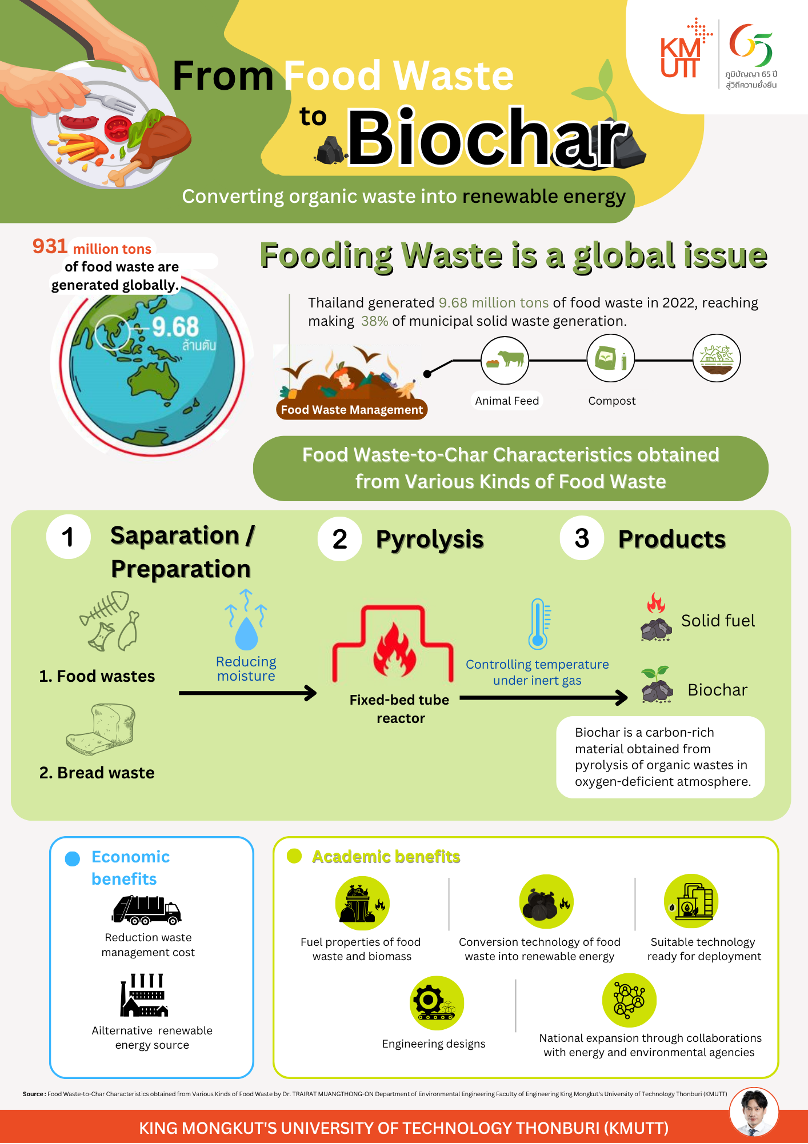
The Food Waste Index Report 2021, published by the United Nations Environment Programme (UNEP), estimates that around 931 million tons of food waste were generated in 2019. Not only is this a waste of food, but it also contributes to approximately 8% of global greenhouse gas emissions. In Thailand, the Pollution Control Department (PCD) reported that 9.68 million tons of food waste, mostly fruit peels and inedible parts, was produced in 2022, making up 38% of municipal solid waste. Given this alarming data, there is an urgent need to manage and utilize food waste effectively.
Typically, food waste management involves using it as animal feed and for composting, while the unusable parts are sent to landfill. This process incurs significant costs, primarily in transportation. “Our team thus set out to explore new ways to manage this food waste and decided on converting it into biochar, that can replace low-rank coals used for heating in various industries,” says Dr. Trairat Muangthong-on from the Department of Environmental Engineering, discussing his project titled “Food Waste-to-Char Characteristics obtained from Various Kinds of Food Waste”.

The study involved collecting waste data generated within KMUTT and gathering food waste samples from canteens. Food waste, separated into food scraps (vegetable peels, fruit skins) and bread waste, was converted into biochar through a pyrolysis process in a fixed-bed tube reactor under controlled temperature and nitrogen concentration for one hour. Various temperatures were tested.
The process transformed food waste into solid fuel, char, and charcoal or biochar, with a higher carbon content and similar fuel properties to low-rank coals used in industries. This technology can be implemented by industries, allowing them to produce biochar from food waste with the dual benefits of reducing both waste management and fuel costs. Its sustainability can be assessed in technical, economic, and environmental dimensions, paving the way for a long-term plan for policy and strategy development.
“Throught this research, we obtained the fuel properties of food waste and biomass, a suitable technology, operational conditions, and engineering designs for implementation. This blueprint is ready to be used by organizations such as the Energy Regulatory Commission, Ministry of Energy, Ministry of Interior, Pollution Control Department, Department of Industrial Works, academia, and the private sector and communities, to implement on a national scale, enabling food waste management and energy cost savings,” explains Dr. Trirath.
Dr. Trirath plans to investigate the production of biochar from food waste in the agri-food industry such as sugar mills, animal feed factories, and supplement manufacturers, as well as food waste from other countries, which may result in biochar with different properties.
“Each type of food waste has different components, resulting in biochar with different properties. Therefore, there are types of food waste out there that can yield better biochar. This research is just the beginning of our investigation into food waste utilization, paving the path for sustainability through waste reduction and decarbonization,” concludes Dr. Trirath.